
Last Updated: October 23, 2026
Quick Summary
Cleaning standards drop over time because the systems that created them were never built to last, so quality peaks after a change and then quietly declines. Written specifications, scored audits, trained staff and named accountability hold a standard far longer than any one-off deep clean.
- Most standards failures combine definition, capability, capacity and oversight failures, so diagnose which cause dominates before spending.
- Two scored audits a month is enough for most premises, checked at the same time of day and ideally unannounced.
- Audit straight after the busiest period, because a space that looks fine at 8am can be visibly worn by 4pm.
- If the same item fails three audits running, the problem is in the definition or the capacity, not the cleaner.
- Recovery costs more than maintenance, and the gap widens the longer drift goes unchecked.
Table of Contents
- Why Cleaning Standards Drop Over Time: The Core Reasons
- Signs of Poor Cleaning You Should Not Ignore
- Use a Cleaning Audit Checklist to Catch Standards Drift Early
- How a Cleaning Quality Control Checklist Keeps Results Consistent
- Why Cleaning Staff Training Is the Difference Between Good and Great
- How to Sustain Cleaning Standards Over the Long Term
- Conclusion
- Frequently Asked Questions
Why Cleaning Standards Drop Over Time: The Core Reasons
Cleaning standards drop over time because the systems that created them were never built to last.
The research backs it up. A study published in Infection Control & Epidemiology on sustaining environmental cleaning practice found that short-term gains in hospital-room cleaning are achievable, but very hard to hold onto.
Here are the core reasons standards slip:
- No written standard. “Clean” lives in someone’s head, so it drifts.
- Activity mistaken for outcome. A mop moving is not the same as a clean floor.
- Time pressure. When a plan promises too much for too little time, cleaners rush and quality falls, a pattern noted in 2026 commercial cleaning trend reporting.
- No inspection. What nobody checks, nobody maintains.
- Staff turnover. New starters inherit habits, not standards.
- Budget cuts. Frequency gets trimmed first, and grime builds in the gap.
- Equipment neglect. A clogged vacuum or flat mop pad spreads dirt instead of removing it.
Each one is fixable. The trouble is that most are invisible until someone complains.
The Improvement Trap: Why Quality Peaks Then Slips
Quality peaks right after a change, then quietly declines. A new cleaner, contract or one-off deep clean produces a visible jump, everyone relaxes, the checklist stops being used, the supervisor stops visiting, and the standard resets to whatever is easiest.
There is a second trap too. Cleaning quality can fall through under-cleaning and over-cleaning. ServiceMaster Clean’s analysis of inconsistent cleaning standards notes that harsh methods used inconsistently damage surfaces just as surely as skipped cleans do.
The most common mistake is celebrating the first clean and cancelling the checks. Within eight to twelve weeks, corners, skirting boards and high-touch surfaces are back where they started, and nobody notices until a landlord, client or inspector does.
Signs of Poor Cleaning You Should Not Ignore
Poor cleaning shows up in specific places long before it shows up in complaints. Read the signs as evidence of a mechanism, the same dusty shelf can mean three different things depending on where it is and how often it reappears.
Start with the observable signs, then diagnose the cause:
- Dust on high-level surfaces, cupboard tops, door frames, extractor hoods, pipework. High-level dust is almost always a route problem: the task exists on paper but the access equipment (step stool, extendable duster) is missing or stored too far away to bother with.
- Sticky or smeared high-touch surfaces, handles, switches, lift buttons, shared keyboards. Smearing usually means too much product or no dwell time, not too little cleaning. The surface is being wiped, but the residue is being spread.
- Dull or scratched floors with visible traffic lanes, traffic lanes reveal where the route is being shortened. Scratches and dullness point to the wrong pad, worn brushes, or grit being dragged rather than removed.
The pattern matters more than any single item. One dusty shelf is normal; dust in the same three places every month is a system problem.
Reading the signs by setting
The same symptom means different things in different premises:
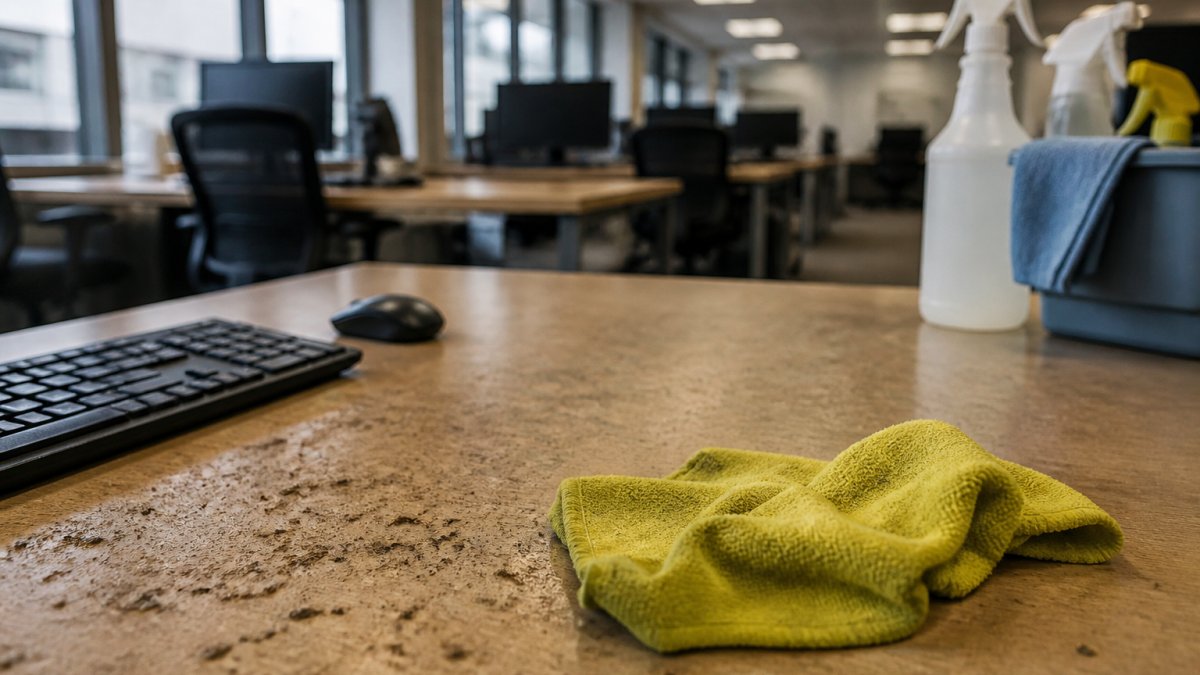
- Offices: the dominant pattern is route-shortening under time pressure. Desks and bins get done; high-level dust, skirtings and under-desk floors slip. The fix is usually a realistic schedule and a scored audit, not more staff.
- Healthcare and care settings: the dominant pattern is high-touch frequency drift. Handrails, door handles and call buttons are the highest-risk surfaces, and they are the first to lose frequency when a shift is short-staffed. The fix is a written high-touch route with a sign-off, checked against the audit.
- Hospitality: the dominant pattern is presentation over hygiene. Rooms look right but bathrooms carry scale and grout discolouration because periodic tasks were trimmed. The fix is a periodic-task register that is reviewed monthly, not just a daily checklist.
Ask a simple question: is the space being cleaned, or just visited? Name the mechanism behind each sign and you can fix the cause rather than chasing the symptom.
Use a Cleaning Audit Checklist to Catch Standards Drift Early
A cleaning audit checklist is a short, scored list of specific areas and surfaces, checked on a set schedule, so you can compare this month’s result with last month’s.

Run it like this:
- Pick 10 to 15 checkpoints per building: entrance, washrooms, kitchen, desks, floors, bins, glass, high-touch points.
- Score each one 1 to 5 against a written description of what “5” looks like.
- Check at the same time of day each visit, ideally unannounced.
- Photograph failures. A photo ends the “it was clean this morning” argument.
- Log the score so you can see a trend line, not a one-off.
- Assign one fix and one owner per failed item, with a deadline.
- Re-check failed items at the next audit.
Two audits a month is enough for most premises. The point is not the score. The point is that someone is looking, and everyone knows it.
Audit straight after the busiest period, not first thing in the morning. A space that looks fine at 8am can be visibly worn by 4pm, and that is the state your staff, tenants or customers actually experience.
How a Cleaning Quality Control Checklist Keeps Results Consistent
A cleaning quality control checklist turns “clean” into a measurable outcome: it lists the tasks, frequency, product and expected finish, and is signed off after each visit.
The difference between a quality control checklist and an audit is simple. The checklist is what the cleaner works to. The audit is what the supervisor checks against.
A practical quality control checklist covers:
- Task and area: what is cleaned, and where
- Frequency: daily, weekly, monthly, periodic
- Method and product: correct dilution, correct cloth, correct dwell time
This is where cleaning outcomes separate from cleaning activity.
Why Cleaning Staff Training Is the Difference Between Good and Great
Cleaning staff training is the single biggest lever on consistency, because most standards fail at delivery, not planning.
Training should cover:
- Product dilution and safe use, including COSHH guidance on hazardous substances
- Colour-coded cloths and the cross-contamination risk of mixing them
- Dwell time: why disinfectant needs contact time to work
The Cleaning Matters coverage of hygiene expectations makes the point that expectations keep rising while labour availability tightens.
There is a hard truth here. Untrained staff do not have low standards. They have no standards to meet, because nobody defined one for them.
How to Sustain Cleaning Standards Over the Long Term
Sustaining standards means building them into the routine so they survive staff changes, busy periods and budget pressure. A spec and an audit are necessary but not sufficient. What holds a standard in place is a closed loop: define, deliver, verify, correct, and feed the correction back into the definition.
The root-cause framework
When a standard slips, resist the urge to blame the cleaner. Work through four causes in order, because each one produces a different remedy:
- Definition failure, ‘clean’ was never written down for that area, so each person interprets it differently. Remedy: an area-by-area specification with an observable finish (streak-free, dry, odour-free, no residue).
- Capability failure, the standard is written but the person delivering it has not been trained on method, dilution, dwell time or equipment. Remedy: structured induction and refresher training, not a one-off briefing.
- Capacity failure, the standard is defined and the person is capable, but the time or equipment allocated makes it impossible. Remedy: realistic schedules, working equipment, and a route that matches the minutes available.
- Oversight failure, the first three are fine, but nobody checks, so drift goes unnoticed until a complaint or inspection. Remedy: scored audits with trend lines and named owners.
Most standards failures are a combination. A rushed cleaner with no dwell time (capacity) who was never shown the method (capability) in an area with no written finish (definition) and no supervisor visit (oversight) is not a bad cleaner, it is a broken system. Diagnosing which cause dominates tells you where to spend the next pound.
The sustained-improvement loop
A standard set and left alone will decay; one reviewed on a cycle will hold. The loop has five steps:
- Define: a written specification per area, reviewed annually and whenever the use of the space changes.
- Deliver: fixed schedules with periodic deep-clean tasks built in, plus preventive maintenance for machines so performance does not quietly drop.
- Verify: scored audits at the same time of day, ideally unannounced, with photographs of failures and a logged trend line.
What holds a standard in place
- A written specification for every area, reviewed yearly
- Fixed schedules with periodic deep-clean tasks built in
- Regular audits with scores shared openly
| Problem | Fix | What It Prevents |
|---|---|---|
| No written standard | Area-by-area specification | Personal interpretation of ‘clean’ |
| Activity over outcome | Scored audits with photos | Ticked boxes with dirty corners |
| Rushed visits | Realistic schedules and timing | Shortcut cleaning under pressure |
| Untrained starters | Structured induction | Inherited bad habits |
| Equipment neglect | Preventive maintenance log | Spread dirt, lost suction, blockages |
| No accountability | Named area owners | Nobody owns the failure |
| Lapsed periodic tasks | Periodic-task register | Scale, grout discolouration, hidden dust |
The cost of letting standards drift
Standards drift is rarely free, even when no one complains. The costs appear in four places:
- Rework: a space that has slipped needs a deeper, more expensive clean to recover than it would have cost to maintain.
- Complaints and reputation: in offices and hospitality, the first visible sign is often a client or guest comment, by which point the drift is months old.
- Illness risk: high-touch surfaces that lose frequency are the ones most associated with onward transmission in shared spaces.
Recovery costs more than maintenance, and the gap widens the longer drift goes unchecked.
Standards do not decay because people stop caring. They decay because nobody is measuring. A written spec, a scored audit, a named owner and a review loop will hold a standard far longer than any one-off deep clean, and they turn ‘why did it slip?’ into ‘which of the four causes was it?’
Conclusion
Holding a cleaning standard is harder than setting one, and the slip is almost always gradual. The fix is a system: a written spec, a scored audit, trained staff and someone accountable for each area.
That is exactly how we work at Excellent Services. Our dedicated team of professionals delivers exceptional results, ensuring your property is maintained to the highest standards.
Book now with Excellent Services and get a standard that is checked, not just promised.
Frequently Asked Questions
Why do cleaning standards drop over time?
Standards slip for predictable reasons: routines become rushed, checklists stop being used, staff turnover erodes training, and nobody measures outcomes. Research in Infection Control & Epidemiology found that short-term cleaning improvements are hard to sustain long term. When cleaning is judged by activity (a mop was used) rather than outcome (the surface is clean), drift goes unnoticed until complaints surface.
What are the signs that cleaning standards are slipping?
Common signs of poor cleaning include dust on high-touch surfaces, smeared glass, unemptied bins, grout discolouration and lingering odours. Less visible are missed corners, unlogged equipment faults and checklists signed without inspection.
How can a cleaning audit checklist maintain consistent standards?
A cleaning audit checklist turns vague expectations into scored, repeatable checks. It should cover high-touch surfaces, floors, washrooms, waste and equipment condition, with a simple pass/fail or 1-5 rating per item. Audits done weekly or fortnightly catch drift before it becomes a complaint, and trends over time show whether training or scheduling needs adjusting.
How often should cleaning standards be reviewed?
Review standards at least quarterly, and after any staff change, complaint or seasonal shift. High-traffic commercial sites benefit from monthly reviews. Pair the review with a fresh audit and a short refresher for staff. Without a scheduled review, standards quietly reset to whatever is easiest rather than what was agreed.

Leave a Reply