

Table of Contents
- Define Your Cleaning Standards and Desired Cleanliness Levels
- Create a Cleaning Schedule Template That Works for Your Space
- Build a Cleaning Quality Control Checklist
- Implement a Cleaning Inspection Checklist and Scoring System
- Develop a Cleaning Staff Training Programme
- Monitor Performance and Track Corrective Actions
- Conclusion
- Frequently Asked Questions
Last Updated: October 16, 2026
Define Your Cleaning Standards and Desired Cleanliness Levels
Consistent cleaning standards start with defining what “clean” means for your space. Without this, your team guesses and misses the mark.
List exactly what must happen in each room.
Create tiers of cleanliness for different areas:
- Daily clean: High-traffic zones that get heavy use
- Weekly deep clean: Rooms that need thorough attention but not daily
- Periodic deep clean: Quarterly or seasonal tasks like window frames or carpet shampooing
Document these standards in writing. Teams with written cleaning standards achieve far better consistency than those relying on verbal instructions alone.
Match cleanliness levels to your property type: a care home has different hygiene requirements than a residential home, and a commercial office differs from a retail shop.
Create a Cleaning Schedule Template That Works for Your Space
A cleaning schedule template is your roadmap: it tells your team what to clean, when and how often. Without one, cleaning becomes reactive, you fix messes instead of preventing them.
Map your space: count rooms, identify high-traffic areas and note surfaces needing frequent attention. Then assign tasks to specific days so work spreads across the week.
Daily, Weekly, and Periodic Tasks
Daily tasks maintain cleanliness between deeper cleans and take 15-30 minutes in most residential homes:
- Wipe kitchen surfaces and appliances
- Clean bathroom mirrors and sinks
- Sweep or vacuum high-traffic floors
Weekly tasks take 1-2 hours depending on space size:
- Mop all hard floors
- Clean inside the oven and microwave
- Dust surfaces and furniture
Periodic tasks happen monthly, quarterly, or seasonally:
- Deep clean carpets or rugs
- Clean inside cupboards and drawers
- Wash walls and skirting boards
Assign one major deep-clean task per week alongside your weekly routine to spread the load and prevent a monthly overhaul.
Build a Cleaning Quality Control Checklist
A cleaning quality control checklist turns vague expectations into measurable tasks, answering: how do I know if this room is actually clean?
List every task for each room, with a checkbox to mark completion. Include specific details:
- Toilet: seat and bowl disinfected, no stains visible
- Mirrors: no streaks, edges cleaned
- Floors: no visible dust or debris, swept and mopped
Make your checklist room-by-room, not one generic list, a bedroom differs from a kitchen. Assign it to the cleaner so they have a clear reference.
Identifying High-Traffic Areas and Priority Zones
High-traffic areas get dirty fastest and shape how clean your space feels. Identify and prioritise them in your quality control process.
Common high-traffic areas include:
- Entryways and hallways
- Kitchen surfaces and appliances
- Bathroom sinks and toilets
These areas belong on your daily checklist, visitors notice a spotless entryway before a dusty bedroom.
Priority zones also include frequently used rooms: meeting rooms and reception in a commercial office, communal spaces and resident bathrooms in a care home.
Implement a Cleaning Inspection Checklist and Scoring System
An inspection checklist measures whether your cleaning standards are actually met. Many teams clean regularly but never verify results. The fix: move from subjective judgements (“looks clean”) to measurable criteria with published thresholds, so two inspectors reach the same verdict.
Build Room-by-Room Pass Criteria
Build one checklist per room type, and write each line item as a pass criterion a third party could verify without asking the cleaner. Examples:
- Toilet bowl: no visible scale or staining below the waterline; rim and seat disinfected; no odour when the lid is lifted.
- Mirror and glass: no streaks, smears or finger marks when viewed at 45° under normal lighting; edges and frames wiped.
- Hard floors: no visible debris, no sticky residue underfoot, no streaks from the mop; edges and corners reached.
Write each criterion as pass/fail rather than a scale. Scales invite drift; pass/fail forces a decision.
Weighted Scoring and Corrective-Action Thresholds
Weight items so hygiene-critical and high-visibility tasks carry more points than cosmetic ones:
- Hygiene-critical (toilet disinfection, food-contact surfaces, clinical or care touchpoints): weight 3
- High-visibility (entrance floors, reception glass, meeting-room tables): weight 2
- Routine (dusting, skirting boards, internal glass): weight 1
Score each item as 1 (pass), 0.5 (partial) or 0 (fail), multiply by the weight, and divide by the maximum possible score for that room. Apply thresholds consistently:
- 95-100%: meets standard, no action.
- 90-94%: minor rework within the same shift; log the item.
- 80-89%: rework before sign-off; supervisor notified; retraining considered if the same item recurs.
Publishing thresholds in advance removes arguments about whether a room “just needs a quick once-over”.
Digital Quality-Control Workflow
Paper checklists get lost, back-dated or ticked from memory. A digital workflow makes inspections auditable:
- Mobile checklist app with the room-by-room criteria above, so the inspector cannot skip items.
- Photo evidence attached to any fail or partial score, taken in-app so the timestamp and location are captured automatically.
- Automatic timestamps on every submission, giving you a defensible audit trail for client reviews, internal audits and any regulatory inspection.
Run a calibration session once a quarter: two supervisors inspect the same room independently and compare scores. Any item where they disagree by more than one point needs its pass criterion rewritten. This is the single fastest way to tighten a scoring system.
Inspection Frequency by Site Type
Match frequency to risk and footfall:
- Care homes and clinical-adjacent spaces: daily visual checks on hygiene-critical items, weekly full scored inspection.
- Commercial offices: weekly scored inspection of reception, meeting rooms and washrooms; monthly full-building inspection.
- Retail and hospitality: daily opening and closing checks on customer-facing areas; weekly scored inspection.
Record every inspection, including passes. A clean audit trail turns “we think it’s consistent” into evidence for a client, landlord or inspector.
Consistency comes from published pass criteria, weighted scores and fixed thresholds, not from an inspector’s opinion on the day. Digitise the checklist so the evidence is timestamped and the corrective action is tracked to closure.
Develop a Cleaning Staff Training Programme
Your cleaning staff are the foundation of consistent cleaning standards. Even the best checklist fails if your team doesn’t know how to use it.
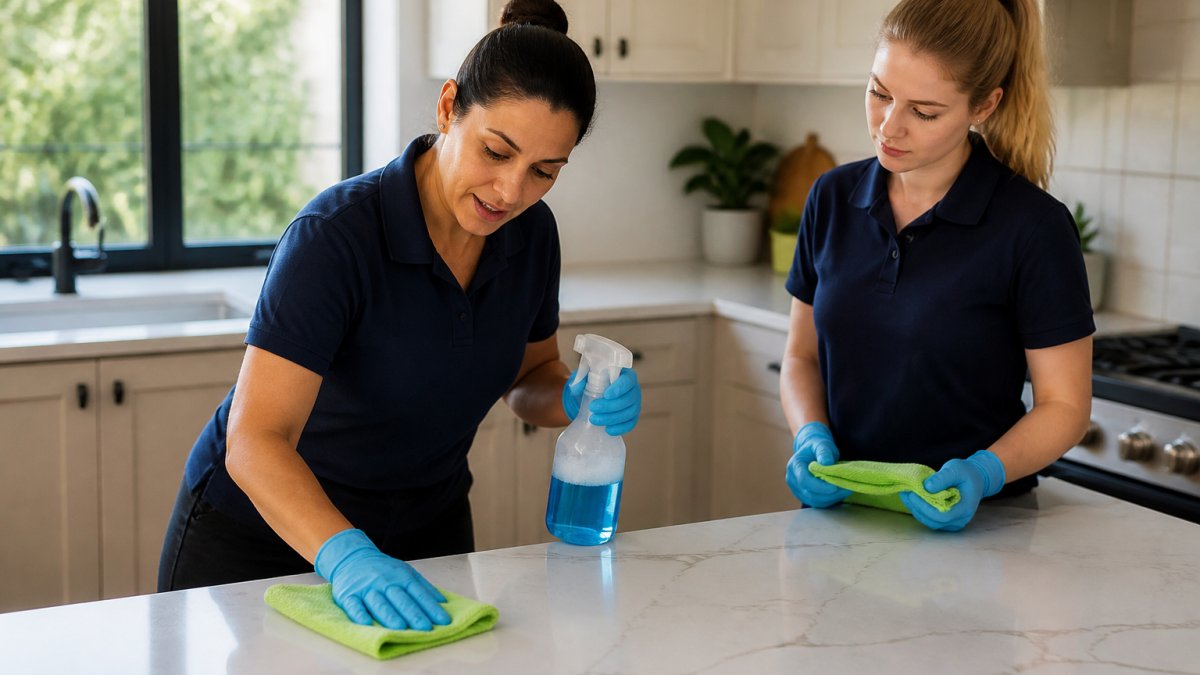
A good programme covers what to clean, how, and why it matters. New team members should shadow an experienced cleaner for a full session before working alone.
Assigning Responsibilities and Documenting Procedures
Clear responsibility assignment stops work falling through the cracks. Assign specific tasks to specific people, don’t assume someone will notice a dirty window.
Document your procedures in writing, showing step-by-step how to do each task. For example:
Procedure: Clean bathroom tiles
- Spray tiles with bathroom cleaner
- Let sit for 2 minutes
- Scrub with a stiff brush, paying attention to grout lines
- Rinse thoroughly with clean water
- Dry with a microfiber cloth to prevent water spots
Include the equipment, products and time required. This removes guesswork and ensures consistency.
Assign tasks by skill: new team members get simpler work, while experienced cleaners handle deep cleaning or delicate surfaces.
Rotate tasks periodically so your team learns all methods and can cover absences.
Monitor Performance and Track Corrective Actions
Monitoring isn’t spying, it’s checking results regularly, finding out why a task failed and proving the fix worked. Most operations stop at “re-clean it and move on”, which is why the same failures reappear. The sections below set out a root-cause and corrective-action loop.
Separate Symptoms from Causes
A low score is a symptom, not a cause. Before you retrain anyone, work through the likely causes:
- Unclear procedure, the cleaner did what they thought was right because the standard was never written down or was written vaguely.
- Insufficient time, the task is on the schedule but the allocated minutes don’t match reality, so corners are cut under pressure.
- Supply or equipment shortage, the correct product, cloth or machine wasn’t available, so a substitute was used.
- Training gap, the procedure is clear and the time is adequate, but the cleaner hasn’t been shown the technique.
- Access or sequencing issue, the room was locked, occupied, or cleaned before a trade finished, so the task was skipped.
- Motivation or accountability, everything else is in place and the task still isn’t done.
Diagnose in that order: failures are far more often time or supply problems than people problems, and retraining someone for a scheduling fault wastes time.
A Corrective-Action Record That Actually Works
Every fail should generate a record with these fields:
- Date and room, pulled automatically from the inspection app.
- Failed item and score, the specific criterion, not “bathroom dirty”.
- Root cause, one of the six categories above.
A corrective action closes only when the re-inspection passes. Anything open beyond its due date escalates to the supervisor automatically.
Connect Standards to Staffing and Time
Standards that ignore time are aspirational, not achievable. Time each task three times under normal conditions, take the middle figure, then add allowance for setup, travel and restocking. A theoretical 20-minute clean often takes 28 minutes once movement and setup are included.
Once you have time standards, test whether the schedule is feasible:
- Total the task times for a shift and compare against paid hours minus breaks and travel.
- If the total exceeds available time by more than about 10%, the schedule is over-committed and standards will slip regardless of effort.
- Either reduce scope, extend the shift, or add resource, but decide deliberately rather than letting the team absorb the shortfall.
Workload fairness matters too: if one cleaner consistently carries a heavier route, their scores drift down for reasons unrelated to skill.
Control Products, Equipment and Stock
Repeatable results depend on the same inputs every time:
- Approved-product list per surface type, with dilution ratios and required contact times posted in the cleaning cupboard. A disinfectant that is wiped off after 10 seconds when the label requires 60 seconds of contact time is not doing its job.
- Colour-coded cloths and mops to prevent cross-contamination between washrooms, kitchens and general areas.
- Equipment maintenance log, vacuum filters, mop heads, squeegees and battery charge cycles. A clogged filter or worn mop head produces inconsistent results no matter how well the cleaner works.
Do not let cleaners substitute products “just for today”. Substitutions are one of the fastest ways to lose consistency, and some combinations (for example, bleach with an acidic descaler) are genuinely hazardous. Keep the approved list short and keep it stocked.
Verify the Fix and Watch the Trend
After a corrective action, re-inspect the same room within the agreed window and compare scores. If nothing has moved, the root cause was misdiagnosed, revisit the six categories.
Track three trends monthly:
- Repeat fails by item, the same criterion failing in the same room three months running points to a systemic cause, not a person.
- Repeat fails by cleaner, if one person accounts for a disproportionate share, check their route, time allocation and equipment before assuming a training issue.
- Time-to-close corrective actions, a rising figure usually means supervisors are overloaded or actions aren’t being owned.
Make It Inclusive and Accessible
Procedures only drive consistency if every cleaner can use them:
- Keep written procedures short, in plain language, and pair them with a photo or short video of the correct technique.
- Translate the top ten procedures into the languages most used by your team, and keep the visual version as the primary reference.
- Use icons and colour coding on checklists so they work for staff with lower literacy or those new to the role.
A corrective action is only finished when a re-inspection proves the score has improved. Diagnose the cause before you retrain, tie standards to realistic time and stock, and track repeat fails by item and by route, not just by person.
Conclusion
Maintaining consistent cleaning standards comes down to four things: define what clean means, create a schedule, inspect regularly and train your team well. Without any one, standards slip.
At Excellent Services, consistency builds trust. Our dedicated team follows documented procedures, responds to feedback, and inspects every job before we consider it complete. If you need professional cleaning that meets high standards reliably, Book Now.
Frequently Asked Questions
How do you maintain high standards of cleanliness consistently?
Consistent cleaning standards rely on four core pillars: a written definition of what clean means for your space, a documented schedule breaking tasks into daily, weekly, and periodic routines, a quality control checklist that covers all areas, and regular inspections with measurable scoring. Train your cleaning team on these standards upfront, assign clear responsibilities, and monitor performance through inspections at least weekly. Document any gaps and take corrective action immediately to prevent standards from slipping.
What should a cleaning quality control checklist include?
A cleaning quality control checklist must specify the condition required for each area: surfaces dust-free, floors swept and mopped, bathrooms sanitised, mirrors streak-free, and high-touch points (door handles, light switches) disinfected. Include specific details like ‘no visible dust on skirting boards’ or ‘grout lines clean’. Assign point values to each task so inspectors can score completion objectively. Cover high-traffic areas separately since they require more frequent attention. Separate checklists for daily, weekly, and deep-cleaning tasks prevent confusion and ensure nothing is missed.
How often should cleaning standards be checked?
Cleaning standards should be inspected at least weekly using a formal inspection checklist and scoring system. For commercial spaces or high-traffic environments, inspect twice weekly or after each cleaning session. For residential properties, a weekly inspection is sufficient for routine maintenance; end-of-tenancy or pre-sale deep cleans warrant a final inspection before sign-off. Use a scoring system (e.g., 0-100 points) to track trends over time and identify which areas or staff members need additional training or resources.
What’s the best way to train cleaning staff to follow the same standards?
Provide initial hands-on training where experienced staff demonstrate correct techniques for each task and area. Document all procedures in a standard operating procedures manual with photos or video examples. Use your cleaning schedule template and quality control checklist as training tools so staff understand what ‘done’ looks like. Conduct monthly refresher training, observe staff during cleaning sessions, and give immediate feedback. Assign a lead cleaner or supervisor to answer questions and reinforce standards. Recognise staff who consistently meet or exceed standards to encourage compliance.
Leave a Reply