

Table of Contents
- End of Tenancy Cleaning Checklist for Tenants 2026: What Really Matters
- What to Clean When Moving Out of a Rented Property: Room-by-Room
- Your End of Tenancy Cleaning Checklist Printable and Mobile-Friendly
- Tenant Cleaning Responsibilities When Moving Out: Fair Wear and Tear
- How Long Does End of Tenancy Cleaning Take? Task Prioritisation
- Property-Specific Variations: Furnished, Unfurnished, Pets and Shared Homes
- Evidence, Deposit Disputes and Photo Documentation Before Handover
- Conclusion: Start Early and Clean to Check-Out Standard
- Frequently Asked Questions
Last Updated: October 7, 2026
End of Tenancy Cleaning Checklist for Tenants 2026: What Really Matters
End of tenancy cleaning is the process of returning a rented property to the standard recorded at check-in, so the deposit can be released in full. This guide gives tenants a room-by-room, dated checklist built around what letting agents actually inspect in 2026.
How to Use This Checklist Before Your Check-Out Inspection
Start at least a week before your check-out inspection. Work top to bottom in each room, cleaning the dirtiest areas first so you are not re-soiling finished floors.
Three rules make the checklist work:
- Compare against your check-in inventory, not your memory. Every item listed there must be returned in comparable condition.
- Photograph as you go, before and after each room.
- Finish 24 hours early, so you have time to fix anything the agent flags.
A common mistake is cleaning the oven last, on the morning of the inspection. Oven cleaner needs dwell time and ventilation. Do it first, leave it working while you clean everything else.
What to Clean When Moving Out of a Rented Property: Room-by-Room
A room-by-room checklist forces you to finish one space before starting the next.
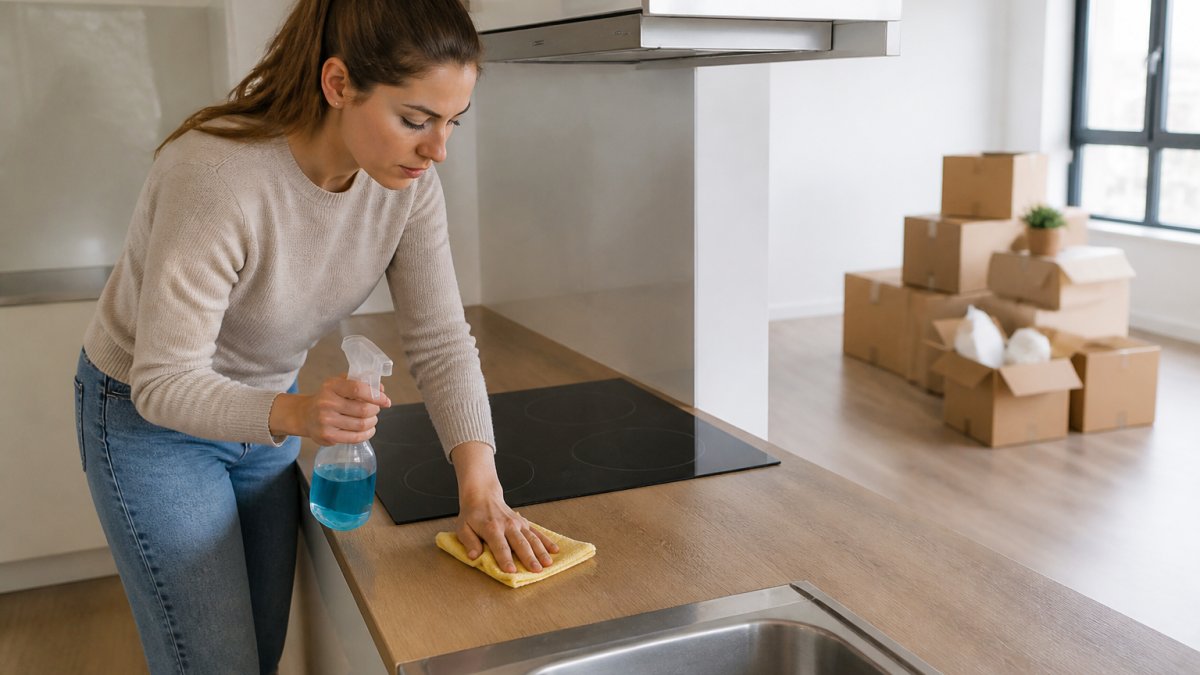
Kitchen: Oven, Hob, Extractor Fan, Fridge and Cupboards
The kitchen is where most deposit deductions originate. Clean the oven, hob, and extractor fan first, then work outward.
- Oven: remove racks and trays, apply cleaner, wipe out the interior, clean the door glass inside and out, and clean the seal.
- Hob: degrease the rings or ceramic surface, and clear the control knobs.
- Extractor fan: replace or wash the grease filter, and wipe the housing.
Bathroom: Limescale, Descale, Mould and Mildew
Limescale and mould are the two items agents look for first in a bathroom. Descale the showerhead by soaking it, then clear the shower screen, tiles, and grout. Wipe the toilet including the base and behind the pan, clean the extractor vent, and treat mildew on sealant with a suitable cleaner. Finish with the mirror, cabinet, and floor.
Floors, Carpets, Upholstery, Doors, Skirting Boards and Windowsills
Floors and fixtures are the last things you clean. Vacuum carpets and upholstery, then mop hard floors with a product suited to the surface. Wipe skirting boards, door frames, handles, and light switches, clean windowsills and frames inside, clear cobwebs, and leave floors to dry with the windows open.
Your End of Tenancy Cleaning Checklist Printable and Mobile-Friendly
This section is the checklist, written so you can copy it into a notes app, print it, or read it off a phone screen while you work, with each room given a clear finish line.
How to Use the Checklist in Print or on a Phone
- Print: copy the room blocks below into a document, set the page to A4 portrait, and print one sheet per room. Tick each line as you finish it, then photograph the completed sheet next to the finished room, together they are stronger evidence than either alone.
- Phone: keep one room per screen. Do not merge rooms into a single long list, scrolling causes tasks to be skipped. Use your notes app’s checkbox feature.
- Completion tracking: mark a room done only when every line is ticked. If you leave a line unticked, write why.
Kitchen Checklist
- Oven interior, racks, trays, door glass (inside and out), and door seal
- Hob surface, rings or ceramic zone, and control knobs
- Extractor fan housing and grease filter (washed or replaced)
Bathroom Checklist
- Showerhead descaled (soak or bag-and-vinegar method)
- Shower screen, tiles, and grout descaled
- Bath, basin, and toilet cleaned, including the base and behind the pan
Bedrooms and Living Areas Checklist
- All surfaces, shelves, and windowsills dusted
- Wardrobe interiors wiped and doors cleaned inside and out
- Bed frame wiped; mattress vacuumed (if staying)
Hallways, Stairs, and Communal Areas (Shared Homes)
- Banister, spindles, and handrail wiped
- Stair carpet vacuumed, including edges and risers
- Front door inside and outside wiped; letterbox and handle cleaned
Fixtures, Fittings, and High-Touch Points
- Skirting boards wiped
- Door frames, doors, and door handles wiped
- Light switches, sockets, and pull cords wiped
Summary Table: Time and Inspection Impact
| Room | Key tasks | Realistic time | Inspection impact |
|---|---|---|---|
| Kitchen | Oven, hob, extractor, fridge, cupboards | 2-3 hours | High |
| Bathroom | Descale, mould, toilet, shower | 1-2 hours | High |
| Bedrooms and living areas | Dust, wipe surfaces, vacuum | 1-2 hours | Medium |
| Floors and fixtures | Vacuum, mop, skirting, windowsills | 1-2 hours | Medium |
| High-touch areas | Switches, handles, sockets | 30 minutes | Medium |
| Hallways and stairs | Banister, carpet edges, front door | 30-45 minutes | Medium |
Print one sheet per room and keep them in a folder as you go. At handover, the folder of ticked sheets plus your dated photos is a far stronger record than a single list of tasks you say you completed.
A checklist only protects your deposit if it produces evidence. Tick each task, photograph each finished room, and keep both until the deposit is returned.
Tenant Cleaning Responsibilities When Moving Out: Fair Wear and Tear
Tenant cleaning responsibilities when moving out are defined by your tenancy agreement and by fair wear and tear, the reasonable deterioration from ordinary living, which you are not expected to reverse. Damage, neglect, and dirt beyond ordinary use are your responsibility.
The practical test is comparison: does the property look as it did at check-in, allowing for normal use over the tenancy? If you are unsure about a specific clause in your agreement, check the official guidance on tenancy deposits before you start cleaning, not after.
Do not use abrasive cleaners on ceramic hobs, enamel, or sealed stone. Scratched surfaces are treated as damage, not wear and tear, and are one of the most common reasons a deduction is upheld.
How Long Does End of Tenancy Cleaning Take? Task Prioritisation
End of tenancy cleaning typically takes six to ten hours for an average two-bedroom property, depending on condition and whether it was cleaned regularly during the tenancy. A property not deep-cleaned in two years can take considerably longer.
Realistic Time by Property Size
| Property size | Typical total time | Notes |
|---|---|---|
| Studio or one-bed flat | 4-6 hours | Oven and bathroom dominate the time |
| Two-bed flat or house | 6-10 hours | The figure most guides quote |
| Three-bed house | 9-14 hours | Add time for stairs, second bathroom, and garden access |
| Four-bed house or larger | 12-18 hours | Best split across two days, or booked as a professional clean |
These are working estimates for one person cleaning without professional equipment. If you are sharing the work, split by room rather than by task, one person per room finishes faster than two swapping tasks in the same room.
Why Some Tasks Carry More Inspection Weight
Not every task is judged equally at check-out. Letting agents and inventory clerks focus on the items hardest to dispute and easiest to photograph:
- Oven and extractor: grease and burnt-on residue are visible, photographable, and almost always listed as a deduction if missed.
- Bathroom limescale and mould: the two items most commonly cited in deposit disputes, because their presence or absence is clear evidence of whether cleaning was done.
- Carpets and upholstery: stains and pet odour are difficult to argue against, and professional carpet cleaning is often the single largest deduction.
A Priority Order for Limited Time
If you cannot finish everything, work in this order and stop only when you run out of time:
- High-impact, high-effort: oven, extractor, bathroom descaling, carpets. These are the deductions most likely to be upheld.
- High-impact, low-effort: high-touch areas, windowsills, skirting boards, door handles. These take minutes and change how the whole property reads.
- Medium-impact: inside cupboards, wardrobe interiors, under-bed areas. Visible only if opened, but often checked.
- Lower-impact: storage areas, garage, external bins. Rarely inspected unless specifically noted in the inventory.
What to Do If You Run Out of Time
Finish the high-impact items completely rather than half-doing everything. A fully cleaned oven and bathroom with an untouched cupboard beats a property where every room is 70% done. If a task genuinely cannot be completed, for example, a carpet clean that needs to dry, tell the letting agent in writing before the inspection, with the reason and the date it will be done.
Do not leave a task half-finished and hope it is not noticed. Half-cleaned ovens and partially descaled showers are among the most common reasons a deduction is upheld, because the evidence of an attempt makes the shortfall obvious.
Plan by property size, prioritise by inspection impact, and if time runs short, finish the high-impact items completely and document anything you could not do.
Property-Specific Variations: Furnished, Unfurnished, Pets and Shared Homes
Furnished, unfurnished, pet-occupied, and shared homes each carry different cleaning obligations. Furnished properties require every inventory item to be cleaned and accounted for, including soft furnishings; unfurnished properties shift the focus to floors, fixtures, and fittings. Pet-occupied homes need extra attention to hair in carpets and upholstery, and to odour. Shared homes need a clear division of tasks, plus one person responsible for the final check.
Tenants in shared or furnished properties who want one final professional clean before handover, rather than coordinating housemates at the last minute.
Evidence, Deposit Disputes and Photo Documentation Before Handover
Photo documentation before handover is the single most effective protection against an unfair deduction. Photograph each room after cleaning, with the date visible, and keep the images until your deposit is returned.
If a deduction is proposed, compare the agent’s evidence against your check-in inventory and your own photographs. Where a dispute cannot be resolved directly, the tenancy deposit scheme that protects your deposit provides a free dispute resolution service; the tenancy deposit protection guidance explains how that process works.
The strongest deposit dispute case is a dated photograph of a clean room next to a check-in inventory entry describing the same room in the same condition.
Conclusion: Start Early and Clean to Check-Out Standard
Deposit deductions are rarely about how hard you cleaned. They are about whether you cleaned the right things and can prove it.
At Excellent Services, we clean to estate agent standards with fixed prices and no hidden fees, backed by our deposit-back guarantee. If a landlord still withholds your deposit after one of our cleans, we return to put it right.
Frequently Asked Questions
What should I include on my end of tenancy cleaning checklist?
Cover every room plus the fixtures tenants often forget. In the kitchen that means the oven, hob, extractor fan, fridge, freezer and inside cupboards. In the bathroom, descale the showerhead and taps and treat any mould or mildew. Then add floors, carpets, upholstery, windowsills, window frames, doors and skirting boards. Finish with high-touch areas such as light switches, handles and banisters. A dated end of tenancy cleaning checklist for tenants 2026 keeps every task visible so nothing is missed before your check-out inspection.
Do tenants have to pay for professional end of tenancy cleaning?
Only if the tenancy agreement requires it. Since the Tenant Fees Act 2019, a landlord or letting agent cannot make you pay for professional cleaning unless the contract clearly states it as a condition. If your agreement is silent, you can clean the rental property yourself to the same standard recorded on your check-in inventory. If professional cleaning is required, keep the receipt as evidence for your deposit return.
How long does end of tenancy cleaning take?
A one-bedroom flat usually takes 4 to 6 hours for one person, a two-bedroom home 6 to 8 hours, and a three-bedroom house 8 to 12 hours. The time depends on condition, limescale build-up, oven state and whether pets lived there. Splitting tasks across several days makes the work easier, and starting early gives you time to re-clean anything the letting agent flags before the property handover.
What should I do if my landlord says the property is not clean enough?
Ask for the specific issues in writing and compare them against your check-in inventory and the check-out inspection report. Photograph the areas in question and check whether the problem is fair wear and tear rather than dirt. If you disagree, request your deposit back through the tenancy deposit scheme’s dispute resolution service, which is free and adjudicates on the evidence both sides provide. A dated checklist and before-and-after photos strengthen your case considerably.
How clean does a rental property need to be when you move out?
It should be returned to the same cleaning standard recorded on your check-in inventory, allowing for fair wear and tear. That means no grease in the oven, no limescale on taps, no mould or mildew in the bathroom, and clean floors, carpets and skirting boards. The property does not need to look brand new, but the letting agent will compare it against the inventory at the check-out inspection, so matching that baseline is what protects your deposit.
What is the 5-5-5 rule for cleaning?
It is a quick daily habit: spend five minutes tidying, five minutes wiping surfaces and five minutes putting items away. It keeps a home manageable between deeper cleans rather than replacing them. For tenants, the real value is routine. If you follow the 5-5-5 rule through your tenancy, the end of tenancy clean becomes far lighter because grease, limescale and clutter never build up to the level that causes deposit deductions.
Leave a Reply