

Table of Contents
- Commercial Cleaning Rates in 2026: What You Need to Know
- 2026 Pricing Comparison Table
- Commercial Cleaning Cost Per Hour
- Commercial Cleaning Prices Per Square Metre
- Factors That Affect Your Cleaning Quote
- Commercial Cleaning Checklist: What’s Included
- Office Cleaning Contract Terms and Total Cost of Ownership
- How to Get an Accurate Cleaning Quote
- Frequently Asked Questions
Last Updated: October 12, 2026
Commercial Cleaning Rates in 2026: What You Need to Know
Commercial cleaning rates in London have shifted noticeably over the past year, and businesses that haven’t reviewed their contracts since 2025 often get a shock at renewal. Understanding what drives pricing lets you negotiate better terms and avoid overpaying.
This guide breaks down how commercial cleaning rates work, what you should expect to pay, and how to get an accurate quote.
2026 Pricing Comparison Table
Most rate tables mix office, end-of-tenancy and window cleaning into one range, making them useless for benchmarking. The table below is scoped by service type, pricing unit and frequency so you can compare like for like.
| Service type | Pricing unit | Typical 2026 range | Frequency assumption | What the range assumes |
|---|---|---|---|---|
| Routine office cleaning (contracted) | Per hour, per cleaner | £18-£28 | Weekly or more often | Standard scope: vacuuming, dusting, bins, hard floors, basic washrooms |
| Routine office cleaning (contracted) | Per m² per visit | £0.15-£0.30 | Weekly or more often | Open-plan, low-obstruction layout, standard finishes |
| Daily office cleaning | Per m² per month | £2.50-£5.00 | 5 visits per week | Includes washrooms, kitchens, consumables restocking |
| Periodic deep clean | Per hour, per cleaner | £25-£40 | One-off or quarterly | Includes furniture moving, behind-equipment cleaning, machine scrubbing |
| End-of-tenancy / dilapidations clean | Per m², one-off | £3.00-£6.00 | One-off | Empty premises, full access, includes appliances and internal glass |
| Internal window and partition cleaning | Per pane or per hour | £2-£5 per pane, or £25-£40 per hour | Monthly or quarterly | Ground-level and reachable internal glass only |
| High-level or external window cleaning | Per hour, per operative | £30-£50 | Quarterly or ad hoc | Access equipment, water-fed poles or MEWP; excludes specialist abseil work |
Assumptions behind these ranges
- Rates are for the 2026 calendar year and reflect advertised and quoted market pricing, not a single provider’s rate card.
- Hourly figures are per operative, not per team. A two-cleaner team at £22 per hour costs £44 per hour on site.
- Per-m² figures assume clear access, standard floor coverings and no hazardous waste.
- All figures exclude VAT, which is charged at the standard rate where the provider is VAT-registered.
- Travel, parking and congestion charges are excluded unless the provider states they are built into the rate.
How to read the ranges
A 200 m² office cleaned weekly sits near the top of the per-m² band because fixed costs spread over little floor area; a 2,000 m² premises cleaned daily sits near the bottom. If a quote falls well below these ranges, check the scope, the saving is usually in what has been removed.
Do not compare an hourly rate against a per-m² rate without converting both to a monthly cost for the same scope and frequency. A £20 per hour rate can be more expensive than a £0.25 per m² rate once hours, frequency and included tasks are aligned.
HMRC guidance on VAT registration thresholds
Commercial Cleaning Cost Per Hour
Hourly rates for commercial cleaning in London reflect several real-world factors.
A cleaner working alone on a straightforward office might charge less per hour; a team handling larger premises with multiple restrooms, kitchens and specialist surfaces could command more. Larger jobs require coordination, more equipment and often a supervisor on site.
Travel time matters too: some providers build cross-London travel into the hourly rate, others charge it separately. Always clarify whether the quoted rate includes travel.
For one-off deep cleans, expect the higher end: moving furniture and tackling buildup that maintenance doesn’t address. A standard maintenance clean might be less per hour; the same team doing a deep clean charges more.
Commercial Cleaning Prices Per Square Metre
Per-square-metre pricing offers a predictable cost model for regular contracts. The typical range varies for standard office cleaning, though this varies with what’s included.
A 1,000 m² office will have a certain cost per clean, which varies depending on what tasks are included and how often the space is serviced.
Smaller offices (under 500 m²) often see higher per-square-metre rates because fixed costs spread across less floor area; larger premises (2,000+ m²) see lower rates because the team’s time is used more efficiently.
What’s included matters enormously: some providers cover only basic vacuuming and desk wiping, others add restroom cleaning, bin emptying and floor care. Always ask for a detailed scope breakdown.
Factors That Affect Your Cleaning Quote
Several variables shift your final cost up or down. Understanding them helps you negotiate fairly.
Office Size and Scope
Larger offices cost more in absolute terms, but per-unit cost often decreases: a 500 m² office might cost £0.30 per m² because the team must travel and set up, while a 2,000 m² space might be £0.18 per m².
Layout also affects cost: an open-plan office cleans faster than the same square meterage split across small rooms and corridors. Specialist surfaces, polished concrete, natural stone, sensitive electronics, require different methods and cost more.
Each additional restroom, kitchen or breakroom adds time and requires different products and techniques.
Cleaning Frequency and Service Schedule
Weekly cleaning costs less per visit than fortnightly cleaning because the team works with lighter buildup; fortnightly visits require more intensive labour as dust and debris accumulate longer.
Daily cleaning (common for high-traffic retail or food-service premises) costs more overall but spreads labour across five lighter visits, which many businesses find more cost-effective than weekly.
One-off cleaning commands a premium because providers must fit it into their schedule and often face unpredictable conditions; regular contracts let them plan routes and staffing efficiently, reducing cost per visit.
Basic Versus Comprehensive Cleaning
Basic cleaning covers vacuuming, dusting, emptying bins and wiping high-touch areas. Comprehensive cleaning adds restroom sanitisation, kitchen deep-clean, floor scrubbing and window cleaning.
Specialist cleaning (carpet shampooing, upholstery, high-level windows) is charged separately and costs significantly more because it requires different equipment and training.
Commercial Cleaning Checklist: What’s Included
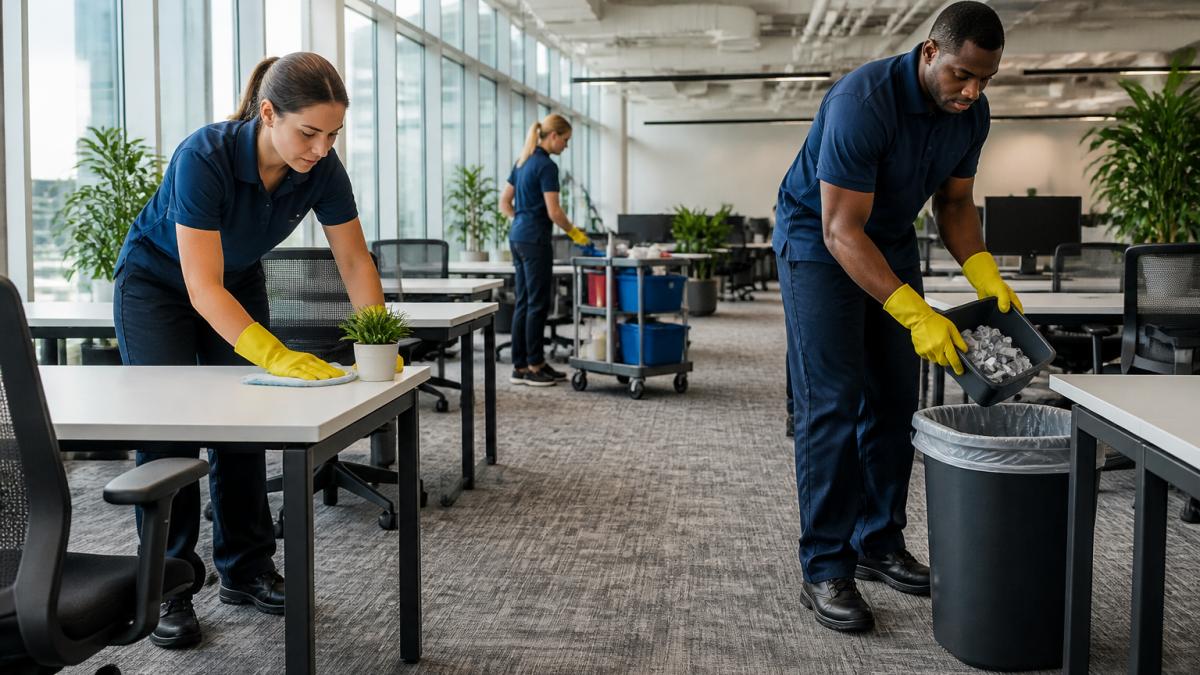
Knowing what cleaners actually do helps you assess whether a quote is fair value. A standard commercial cleaning scope typically includes:
- Vacuuming all carpeted areas
- Dusting desks, shelves, and surfaces
- Emptying and replacing bin liners
- Wiping down door handles and light switches
- Basic restroom cleaning (toilet, sink, mirror)
- Mopping hard floors
- Restocking toilet paper and soap dispensers
Comprehensive cleaning adds:
- Deep restroom sanitisation (grout, tiles, behind fixtures)
- Kitchen equipment cleaning (microwave, fridge interior, stovetop)
- Carpet shampooing or deep scrubbing
- High-level dusting (tops of cabinets, vents, light fittings)
- Window and glass cleaning
- Floor stripping and sealing (periodic, not every visit)
Always request a written scope of work: vague quotes like “full office cleaning” hide assumptions, while a detailed checklist prevents disputes and ensures consistent service.
Office Cleaning Contract Terms and Total Cost of Ownership
The monthly rate is only one line in the budget.
Minimum hours and minimum visit charges
Most providers set a minimum billable visit, commonly two to three hours, regardless of how long the job takes.
Mobilisation and setup charges
Some contracts include a one-off mobilisation fee covering the initial deep clean, site induction, key or fob issue and equipment delivery, typically one to two weeks of the monthly rate.
Out-of-hours and weekend premiums
Cleaning outside standard hours, early morning, evening, weekends or bank holidays, usually carries a 10-25% premium on the hourly rate. If your building requires cleaning after 18:00 or before 07:00, expect this quoted separately.
Consumables
Toilet paper, hand soap, paper towels, bin liners and chemicals are sometimes included and sometimes recharged at cost plus margin, commonly several hundred pounds a year for a mid-sized office.
Travel, parking and congestion charges
If your premises sits inside a charging zone or has no on-site parking, expect these costs passed through. Ask for them to be capped or included in the fixed rate.
Insurance and vetting
Reputable providers carry public liability insurance (commonly £1m-£5m) and employer’s liability insurance, a legal requirement for most employers. Ask for the certificate and confirm staff are DBS-checked where they access your premises or sensitive areas.
Contract length, notice and exit
Typical terms run 3, 6 or 12 months. Longer terms often attract a 5-10% discount but may carry an early-termination charge equal to the remaining months.
A worked total cost of ownership example
Take a 500 m² office cleaned five evenings a week:
- Base cleaning: £0.22 per m² per visit × 500 m² × 21 visits per month ≈ £2,310
- Out-of-hours premium (15%): ≈ £347
- Consumables: ≈ £120
- Parking and congestion: ≈ £80
- Monthly total: ≈ £2,857, or roughly £34,300 a year before VAT
The headline rate alone would have suggested about £27,700 a year. The difference, over £6,500, is the total cost of ownership gap that a rate-only comparison hides.
Ask every provider for a single annual figure that includes base cleaning, premiums, consumables, travel and any mobilisation fee. That is the number to compare, not the hourly rate.
Health and Safety Executive guidance on cleaning and hygiene in the workplace
How to Get an Accurate Cleaning Quote
Getting a fair quote requires clear information and the right questions.
First, measure your premises accurately: providers need square meterage, room count, restroom count and floor types. Rough estimates lead to inaccurate quotes, so use a tape measure or ask your landlord for the floor plan.
Second, define your scope clearly: daily vacuuming, weekly restroom deep-clean, fortnightly window cleaning, monthly floor stripping. Providers interpret “office cleaning” differently, and a written scope prevents misunderstandings.
Third, specify frequency and timing: daily, weekly or fortnightly, and whether early morning or evening suits best. Weekend cleaning costs more as it falls outside standard working hours.
Request a site visit. Reputable providers visit before quoting to assess access, parking, waste disposal, water supply and specialist requirements, far more accurate than a phone-call quote.
Ask for a detailed breakdown: hourly or per-square-metre rates, what’s included in the base price, what costs extra, contract length, notice period, insurance coverage and any longer-commitment discounts.
Compare apples to apples. If one provider quotes £500 a month and another £700, the difference might be that one includes window cleaning. Ensure each quote covers the same scope before deciding on price alone.
Getting commercial cleaning rates right means understanding what drives cost and what you’re actually paying for. The market range reflects real differences in service quality, frequency and scope, not just profit margins. Request detailed quotes from providers who visit your site, define your scope clearly, and compare what’s included, not just the headline price.
Frequently Asked Questions
How much does commercial cleaning cost per hour in 2026?
Hourly rates for commercial cleaning vary by location and service scope. In London, rates vary for standard office cleaning, with one-off deep cleans commanding higher rates. The exact cost depends on office size, cleaning frequency, and whether additional services like window cleaning or carpet shampooing are required. Request a site assessment for a transparent quote tailored to your premises.
What is the average cost of office cleaning in London?
Office cleaning costs in London depend on several variables: premises size, cleaning frequency, and service depth. Daily cleaning services cost more per visit than fortnightly schedules. A small office cleaned weekly will cost considerably less than a large commercial space cleaned daily. Per-square-metre rates offer another benchmark. To establish what you’ll pay, describe your premises size, current condition, and desired cleaning frequency to receive a detailed quote.
Is commercial cleaning charged by the hour or by the square metre?
Commercial cleaning companies use both pricing models. Hourly rates suit one-off cleans or irregular services, while per-square-metre pricing works well for regular contracts with predictable scope. Some providers blend both: a base hourly rate plus adjustments for premises size. Transparent pricing should clearly state which model applies, what tasks are included, and whether VAT is added. Clarify the pricing structure before signing an office cleaning contract.
What factors affect my commercial cleaning quote?
Key factors include office size (measured in square metres), cleaning frequency (daily, weekly, fortnightly, or one-off), service scope (basic restroom and bin emptying versus comprehensive dusting and breakroom cleaning), and site condition. Additional charges may apply for specialist tasks like window cleaning or carpet shampooing. Labour costs and cleaner wages also vary by region. A professional site assessment will identify all factors affecting your final quote.
What should be included in a commercial cleaning checklist?
A standard commercial cleaning checklist covers dusting surfaces, vacuuming floors, emptying bins, restroom cleaning and restocking, breakroom cleaning, and wiping down desks. Comprehensive cleaning adds tasks like carpet shampooing, high-level dusting, and window cleaning. Your cleaning service should provide a detailed checklist showing exactly what’s included in your contract. Clarify whether cleaning products and equipment are supplied by the cleaning company or if you provide them, and confirm the standard of work expected.
Leave a Reply