

Table of Contents
- Why Professional Cleaning Signs Matter Before You Book
- How to Choose a Cleaning Service: Trust Checks Most People Skip
- Professional Cleaning Standards You Can Actually Verify
- What to Expect From a Professional Cleaner on the First Visit
- A Professional House Cleaning Checklist: Room by Room
- Signs of a Professional Cleaning Service in the Finished Result
- Frequently Asked Questions
Last Updated: October 9, 2026
Why Professional Cleaning Signs Matter Before You Book
Choosing a professional cleaning service is a trust decision, not just a price decision. The signs are easy to spot once you know what to look for: clear standards, trained staff, insured teams, and a finished result you can check room by room. At Excellent Services, we have cleaned homes and commercial premises across London, Bromley, Kent, and Croydon.
A cheap quote often hides weak checks: no insurance, no vetting, no fixed scope of work. You find out the hard way, usually after a deposit dispute or a cancelled visit.
Below, we break down the seven checks that separate a genuinely professional cleaning company from a casual one, plus what a good clean should look like when finished, so you can judge the work yourself.
Booking on price alone is a common mistake. A low quote often means no insurance, no DBS checks, and no written scope. If something gets damaged, you carry the cost.
How to Choose a Cleaning Service: Trust Checks Most People Skip
The fastest way to choose a cleaning service is to check four things before you book: insurance, staff vetting, a written scope of work, and a clear complaints process. Skip any one and you are gambling on reliability.
Most guides stop there. What separates a professional cleaning company from a casual one is whether the paperwork stands up to scrutiny and whether the provider shows you a process rather than a promise.
Here is the checklist we would run through ourselves, with the verification step most people miss:
- Insurance: Ask for proof of public liability cover. A professional cleaner carries it; a casual one usually does not. Do not accept a verbal yes, see the certificate and check it is current, the cover level is stated, and the trading name matches the company you are hiring. If a sole trader is subcontracting, ask whose policy applies on the day.
- Vetting: Ask whether staff are DBS checked. This matters most for domestic work where cleaners hold keys. A basic DBS check covers unspent convictions; an enhanced check goes further. Ask which level the company uses for roles with access to your home, and whether checks are repeated or only done at hire.
- Written scope: Get the task list in writing before the first visit. Verbal promises fade fast. The scope should name rooms, tasks, and frequencies, not “general clean”, and state what is excluded (inside ovens, inside windows, external areas, biohazard or pest waste).
- Fixed pricing: Confirm there are no hidden fees for parking, travel, or extra time. Ask what triggers a price change mid-job and who authorises it.
- References or reviews: Look for feedback from regular clients, not one-off jobs. Long client retention is a stronger signal than a handful of five-star reviews from single visits.
- Cancellation policy: Check what happens if they cancel on you, not just if you cancel on them. A professional provider has a cover arrangement, a named substitute or rescheduled slot, rather than leaving you without a clean.
- Deposit terms: For end-of-tenancy work, ask what happens if the landlord is not satisfied. A credible provider will have a defined re-clean window and a written remedy, not an informal “we’ll sort it”.
The Information Commissioner’s Office guidance on data protection is worth a look if a cleaner will hold keys or alarm codes.
Two more checks most guides miss:
Staff training and induction. Ask what training a new cleaner completes before working unsupervised, and whether it is refreshed. A company that cannot describe its induction relies on the individual, not the system.
Staff turnover. Ask how long the same cleaner has been with the company. High turnover is the top reason standards drop after a strong first visit: the person who learned your preferences has left and nobody briefed the replacement.
Ask for the name of the person who will actually clean your home, and how long they have worked for the company. If the answer is vague, expect inconsistency.
If you want one question that reveals the most, ask what happens if you are not happy with a clean. A professional company will describe a complaint route, a timescale, and a corrective action. A casual one will say it has never happened.
Professional Cleaning Standards You Can Actually Verify
Professional cleaning standards are the written rules a company follows for every job, from how products are diluted to how long a bathroom takes. Verify them by asking for the task list, method statement, and product safety data sheets.
Most articles tell you to “look for quality”, useless advice. You need checks you can measure.
Here is what to ask for:
| What to request | Why it matters | What a good answer looks like |
|---|---|---|
| Written task list | Shows scope of work | Room-by-room, with frequencies |
| Method statement | Shows how tasks are done | Named products, dilution, dwell times |
| Insurance certificate | Protects you if damage occurs | Current public liability cover |
| Staff training record | Shows consistency | Induction plus ongoing training |
| Product safety data | Shows safe use of chemicals | COSHH-compliant data sheets |
The Health and Safety Executive guidance on COSHH sets out how cleaning chemicals must be assessed and stored. A professional cleaning company will know this and keep records.
On cross-contamination: colour-coded cloths matter. A cleaner who uses the same cloth on a toilet then a kitchen worktop spreads bacteria rather than removing it. Ask how they separate bathroom and kitchen equipment.
What to Expect From a Professional Cleaner on the First Visit
On a first visit, expect a walkthrough, a confirmed scope, and a clean in set order: dusting top-down, then surfaces, then floors last.
The routine is the easy part to describe.
Here is what should happen, and what to ask for at each stage:
- Arrival and walkthrough. They check the property, note problem areas, and confirm the task list. Ask for the walkthrough notes in writing, a short email or job sheet listing agreed priorities is normal.
- Top-down dusting. Ceilings, light fittings, and high shelves first, so dust falls onto surfaces still to be cleaned. Working top-down avoids re-contaminating surfaces you have already cleaned.
- Surface cleaning. Worktops, skirting boards, door handles, and switches. High-touch points, handles, switches, taps, rails, should be treated as a distinct pass, not wiped incidentally.
- Bathroom and kitchen deep clean. These two rooms take the most time and should be done with separate, colour-coded cloths. Colour coding is a cross-contamination control: a cloth used on a toilet should never touch a kitchen worktop. Ask how the company separates equipment, and whether cloths are laundered between visits or rooms.
- Floors last. Vacuum, then mop, so nothing is walked back over. On hard floors, ask whether the mop water is changed between areas, reusing dirty water spreads soil rather than removing it.
- Final check. They walk the property with you or send photos. A professional provider has a defined inspection step, not the cleaner’s own judgement.
What a written scope should contain
A first visit is only as good as the scope behind it. Before the clean, ask for a document stating:
- The rooms and areas covered
- The tasks in each room, and how often they are done
- What is excluded (inside ovens, inside windows, external areas, biohazard or pest waste)
- The standard the work is judged against
- The re-clean window if something is missed
- Who to contact if you are not satisfied, and by when
Inspection and corrective action
A professional provider inspects its own work. Ask whether inspections are done by the cleaner, a supervisor, or a separate quality check, and how often.
If something is missed, the remedy should be defined: a re-clean within a set window, at no extra cost, to the same standard.
If you are moving out, end-of-tenancy standards matter.
A common mistake is assuming all cleaners work to the same standard. They do not. Some skip skirting boards, inside windows, and appliance fronts entirely.
The first visit tells you about the cleaner. The written scope, inspection step, and re-clean terms tell you about the company. Judge both.
A Professional House Cleaning Checklist: Room by Room
A professional house cleaning checklist should cover every room, including the areas people forget: under furniture, inside the oven, behind the toilet, and on top of the fridge. Use this list to check the work yourself.
Kitchen
- Worktops, splashbacks, and cupboard fronts wiped
- Oven, hob, and extractor cleaned
- Sink and taps descaled
- Appliance fronts and handles wiped
- Bins emptied and sanitised
- Floor vacuumed and mopped
Bathroom
- Toilet cleaned inside and out, including the base and behind the pan
- Shower screen and tiles descaled
- Sink, taps, and mirror polished
- Extractor vent dusted
- Floor mopped with a separate cloth
Living areas and bedrooms
- Surfaces and skirting boards dusted
- Light switches, handles, and sockets wiped
- Under furniture vacuumed where reachable
- Mirrors and glass polished
- Beds made or linen changed if agreed
Hallways and reception areas
- High-traffic areas vacuumed
- Front door and handles wiped
- Clutter tidied to an agreed level
Overlooked areas
- Inside windows and sills
- Tops of wardrobes and cupboards
- Under sofa cushions
- Radiator fins and vents
The quickest way to test a clean is to run a finger along the top of a door frame and check behind the toilet. If both are clean, the rest usually is too.
Signs of a Professional Cleaning Service in the Finished Result
The clearest signs of a professional cleaning service show up in the finished result: no dust on high surfaces, no streaks on glass, no odours, and floors that feel clean underfoot. You should be able to check the work yourself, room by room.
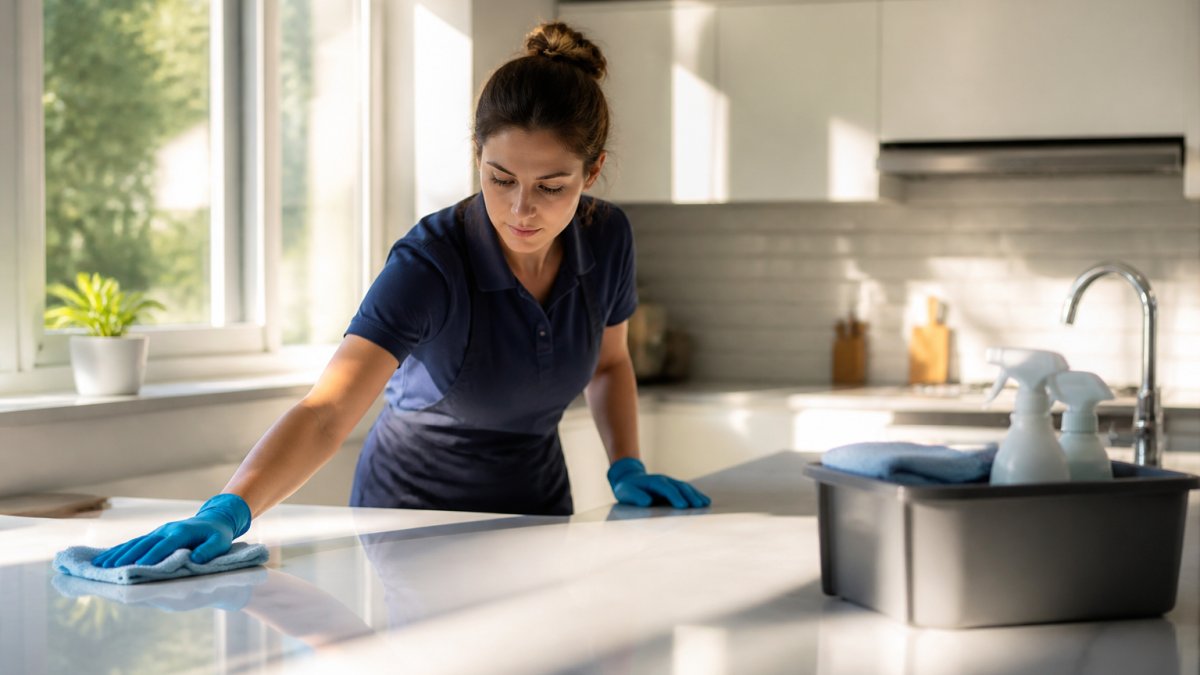
Look for these signals:
- Visual cleanliness. Sparkling surfaces, clean floors, and spotless bathrooms with no water marks.
- No dust, dirt, or grime. Check skirting boards, door tops, and light fittings.
- Stains removed. Limescale, grease, and marks gone, not just wiped over.
- Fresh-smelling rooms. A clean smell, not heavy perfume covering odours. Bins should be empty and waste removed.
- Tidy reception areas. Clutter cleared, cushions straightened, and items put back where they belong.
- Consistency. The same standard on visit ten as on visit one. This is the hardest sign to fake.
What most guides miss is that a strong first clean proves nothing on its own. Anyone can do one good job. Consistency, reliability, and attention to detail over months separate a professional cleaning company from a casual one.
That is why the deposit-back guarantee matters for end-of-tenancy work. It puts the company’s money behind the standard, not just its words.
Hiring a cleaner should not feel like a gamble. If you want a team that is fully equipped, insured, and held to a written standard on every visit, Excellent Services can help.
Frequently Asked Questions
What are the signs of a professional cleaning service?
Look for a written scope of work, proof of insurance, a consistent team, and a checklist covering overlooked areas like skirting boards, appliance seals, and extractor filters. Professional cleaning also shows in the finish: no streaks on glass, no dust on high ledges, bins emptied, and a fresh smell rather than heavy fragrance. Ask whether quality is checked after each visit, and whether you get a named contact if something is missed.
How often should a professional cleaner clean a home?
Most households book weekly or fortnightly for routine cleaning, with a deeper clean once or twice a year. If you have pets, allergies, or a busy household, weekly visits keep on top of dust, floors, and bathrooms more easily. End-of-tenancy and pre-sale cleans are one-off jobs with a different checklist. Ask the provider to recommend a cleaning schedule based on your property size and how much housework you want to hand over.
What should a professional cleaner include in a clean?
A standard visit covers floors, surfaces, bathrooms, kitchen worktops and appliance exteriors, bins, and high-traffic areas. A professional house cleaning checklist should also name the extras: inside the oven or fridge, limescale removal, skirting boards, light switches, and internal glass. Ask for the checklist in writing before booking so you know what is included and what counts as a deep cleaning add-on.
How can you tell if a cleaning company is reliable?
Reliability shows in small things before the first visit: they confirm bookings, arrive when they say, and tell you in advance if a slot changes. Ask what happens if a cleaner cancels, whether the same team attends each time, and whether staff are screened and trained. A company that offers a deposit-back guarantee, fixed prices with no hidden fees, and a clear complaints route is easier to hold to account.
Leave a Reply